- Data source
- Google Maps business listings in the home builder and custom home builder categories, and the public homepage and up to 3 inner pages of each builder's own website, read with robots.txt respected
- Collected
- November 2026
- Sample
- 782 builder websites from listings in all 50 states, about 30 listings per state; 673 had readable text and every share is out of those 673
Key findings
- 110.8% of 673 home builder websites offer a 3D or virtual tour.
- 24.6% of builder websites carry a tour player or link from a 3D tour host on their own pages.
- 328.8% of builder websites use YouTube or another video host, more than two and a half times the share with a tour.
- 414.9% of production and other builder sites offer a tour, against 8% of custom builder sites.
- 5Midwest builder sites offer tours most often, at 14.6%, against 8.9% in the Northeast.
- 622.7% of builder sites that label images as renderings also offer a tour, about twice the rate across all builder sites.
Summary
A couple relocating for work narrows their search to three new communities in a city they have visited once. The first builder's plan page has elevations, a floor plan and a gallery. The second adds a short video of the model. The third has a walkthrough: they move through the model from the foyer to the owner's suite and back, and decide that is the one they will see in person.
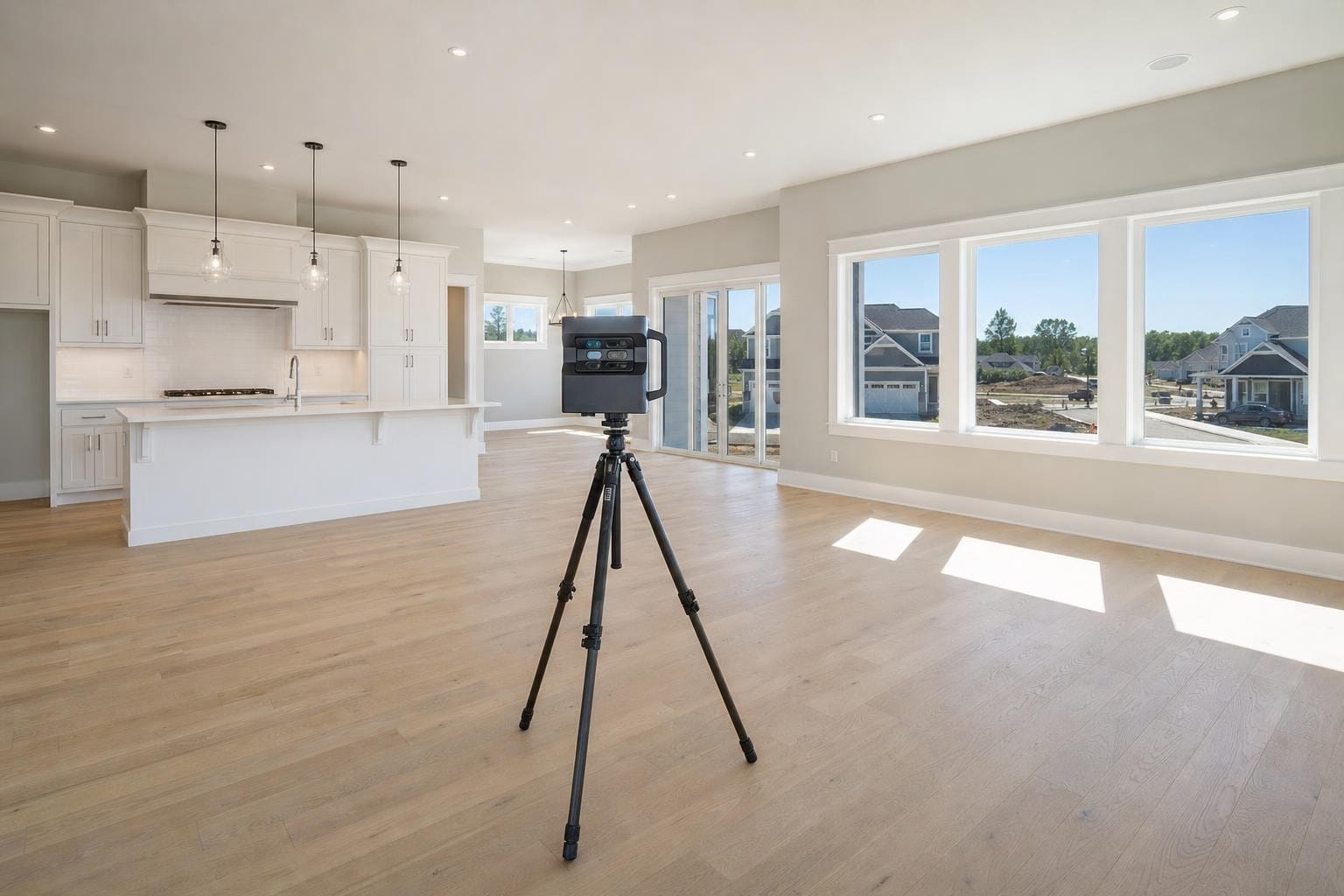
New-home buyers often choose a plan before the house exists, so the builder's website has to stand in for the walk through a finished home. Home builder virtual tours promise to do that, with a scan of the model that buyers can explore from anywhere. We read the public websites of 673 builders across the US to see how many offer a tour, how many host it on their own pages, and which builders use them.
Tours are still a minority feature. 10.8% of builder sites offer a 3D or virtual tour, and only 4.6% carry the tour player itself. Video is much more common, on 28.8% of sites. Production builders, who sell the same plan many times, offer tours almost twice as often as custom builders, 14.9% against 8%.
What we measured
In November 2026 we took Google Maps business listings in the home builder and custom home builder categories, about 30 per state in all 50 states, and kept those with their own website, one per domain, setting aside social media pages and directory profiles. We kept listings whose Google category names a builder, construction company or contractor, which left 782 websites. For each one we read the homepage and up to 3 inner pages picked from its links, such as model, community, floor plan, gallery and tour pages, without running scripts. We read robots.txt first and skipped any page it disallows. 673 sites had at least 300 characters of readable text; the other 109, including 9 that disallow reading in robots.txt, are left out, and every share is out of the 673.
A site offers a tour when its page code or links point to a known 3D tour host, or its text offers a 3D, virtual or interactive tour, walkthrough or model, or a 360 tour. A tour embed is the narrower test: a player, script or link from a 3D tour host in the page code. Video means a player or link from YouTube or another video host. Rendering language means text that labels images as renderings, artist's conceptions or illustrations, or says images are representative. Custom builders are those whose Google category says custom or whose homepage describes custom homes or custom builds; the rest are production and other builders. Regions are the four US Census regions.
Limits: pages were read without running scripts, so tours loaded only by scripts are missed, and a tour on a community page deeper than the 4 pages read will not be counted. A text mention can describe a tour offered on request rather than one on the site. Public archives of website code cover too few builder sites by domain to add a second count, so this study uses the website reading only. Listings are the ones Google returns first in each state, about the same number per state, so national figures weight states equally.
10.8% of builder sites offer a 3D or virtual tour
of home builder websites offer a 3D or virtual tour
Of the 673 builder websites, 10.8% offer a 3D or virtual tour in some form. Fewer than half of them host the tour on the page: 4.6% of all sites carry a player, script or link from a 3D tour host. The rest mention a virtual tour or walkthrough in text, which can point to a tour on a listing portal, a video labeled as a tour or a tour available on request.
Video is on more than a quarter of builder sites; hosted 3D tours on fewer than one in twenty.
Home builder virtual tours sit well behind video. 28.8% of builder websites use YouTube or another video host, more than two and a half times the share with any tour. Video is cheaper to make, works on any device and can show a finished home, a community or the build process, while a 3D tour needs a finished, furnished model to scan.
Production builders offer tours almost twice as often
of production and of custom builder sites offer a 3D or virtual tour
The 275 production and other builder sites offer a tour 14.9% of the time, against 8% of the 398 custom builder sites. A production builder sells the same floor plan many times, so one scan of a model serves every buyer of that plan for as long as it is on the market. A custom builder's next house is different from the last, so a tour shows past work rather than the buyer's home.
| Builder type | Sites | Offers a tour |
|---|---|---|
| Production and other builders | 275 | 14.9% |
| Custom builders | 398 | 8% |
| All builders | 673 | 10.8% |
Source: Stagingmate analysis of 673 US home builder websites · public pages read November 2026
That makes the tour a production builder's tool more than a custom builder's, even though custom builders are the majority of builders in this sample. For a custom builder, a walkthrough of a recent build works as a portfolio piece, showing finish quality and layout choices a buyer can ask for again.
Midwest builder sites offer tours most often, at 14.6%
of Midwest home builder websites offer a 3D or virtual tour
Tours are most common on Midwest builder sites, 14.6% of 158, and least common in the Northeast, 8.9% of 135. The South, at 10.2% of 196, and the West, at 9.8% of 184, sit close to the national figure. Every region has at least 135 sites, but the gaps are a few percentage points.
Midwest builders lead on tours; the other three regions sit between 8.9% and 10.2%.
Regional figures count sites by the state of the builder's Google listing, and each state contributes about the same number of builders. The Midwest lead is the clearest regional difference in the data, but in every region roughly nine in ten builder sites still show no tour.
Builders that show renderings add tours twice as often
of builder sites with rendering language also offer a 3D or virtual tour
Among builder sites that label images as renderings or illustrations, 22.7% also offer a 3D or virtual tour, about twice the 10.8% across all builder sites. Renderings and tours turn up together because both serve the same job: showing a home that the buyer cannot yet walk through, either because it has not been built or because it is in another city.
That pairing points to a group of builders that put more into showing homes buyers cannot visit yet, using drawn images and walkthroughs side by side. Most builder sites use neither. For them, the common path is a gallery of finished work, with video on 28.8% of sites.
What this means for home builders
A tour still sets a builder apart. With 10.8% of builder sites offering one and 4.6% hosting it on their own pages, a walkthrough on the floor plan page is a feature most competitors lack. Home builder virtual tours pay back best where one model serves many sales, which is why production builders use them almost twice as often as custom builders.
A tour is only as good as the model it scans. An unfurnished spec home photographs and scans as a set of bare rooms, and 3d virtual staging adds furniture to the walkthrough as well as the still photos, so buyers see how each room lives without a furnished model on site.
Video is the easier first step for builders with neither: 28.8% already use it. Builders in large new-home markets face the most competition for remote buyers, and the virtual staging texas page shows how staged photos are used on Texas listings, including new builds.
Cite and download
Stagingmate Research. (2026). Home Builder Virtual Tours Appear on 10.8% of Sites. Stagingmate. https://stagingmate.com/research/virtual-tours-on-home-builder-websites
Free to use and republish, as long as you credit Stagingmate Research with a link to this page. Need a local cut or a quote? Email support@stagingmate.com.
Frequently asked questions
10.8% of 673 home builder websites offer a 3D or virtual tour, and 4.6% carry the tour player or link on their own pages.
Yes. 28.8% of builder websites use YouTube or another video host, more than two and a half times the 10.8% that offer a tour.
Yes. 14.9% of production and other builder sites offer a tour, against 8% of custom builder sites.
The Midwest, where 14.6% of builder websites offer a tour. The Northeast is lowest at 8.9%.
More often than others. 22.7% of builder sites that label images as renderings also offer a tour, about twice the 10.8% across all builder sites.